
Adaptation and Resilience
| GHHIN |8 October 2026
Living with Heat in India: Heat-Health Risks, Vulnerability and Emerging Responses
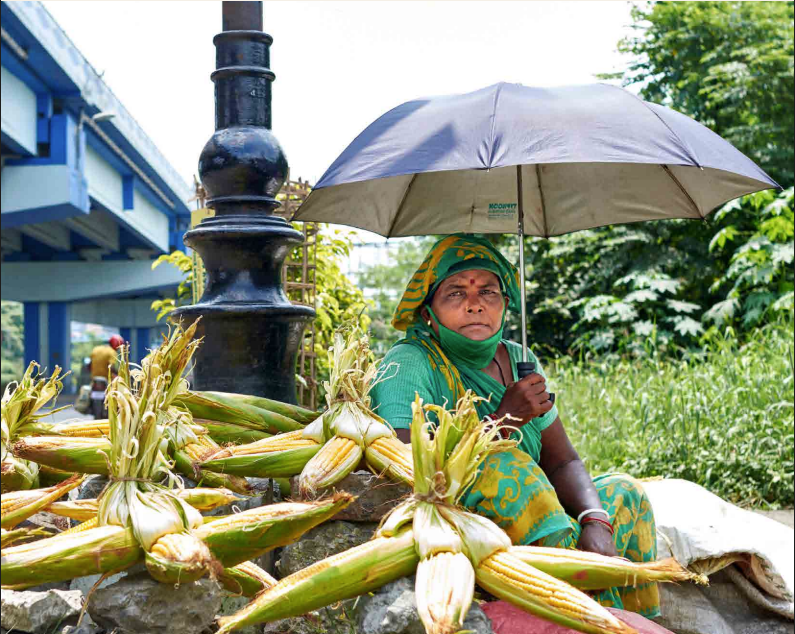
A street vendor sells corn from the roadside, shading herself from the sun with an umbrella. Image: iStock
Overview
This report examines India’s evolving heat risk and its implications for population health, with a focus on changing heat exposure, the populations and places most at risk, and the institutional and policy responses emerging across the country. It assesses India’s progress in responding to extreme heat, identifies gaps in implementation, coordination, data and financing, and consolidates priorities for strengthening long-term heat resilience. The report also highlights practical approaches being tested on the ground and considers how emerging evidence can inform scalable, context-specific responses to the health, livelihood and socioeconomic impacts of extreme heat.
The report draws on historical and projected temperature data, alongside evidence on heat-related health impacts, vulnerability and adaptation. It examines India’s heat governance landscape, including Heat Action Plans (HAPs), health-system preparedness, heat-health surveillance, early warning systems, and interventions led by non-governmental and community-based organisations. It then identifies priorities for institutionalising long-term heat resilience, including mainstreaming heat action across sectors and levels of governance, strengthening institutional and health-system capacities and coordination, unlocking finance for adaptation, and embedding health outcomes in the planning, implementation and evaluation of heat action.
Key Highlights
– India’s temperatures are rising; the average temperature during 2015-2024 was about 0.890C higher than the 1901-30 baseline, with 2024 recorded as the warmest year since 1901.
– The warming is uneven across seasons and regions. Northwestern and central India are experiencing frequent heatwaves, with a predicted expansion to the southern peninsula and a rise in humid heat.
– Extreme heat is increasing health risks, with increasing evidence on heat-related mortalities and illnesses, including links to cardiovascular, kidney, and pregnancy risks.
– Outdoor workers face significant productivity and earning losses due to heat stress, highlighting the need for a calibrated work-rest schedule and basic water, shade, rest and cooling provisions.
– Urban heat islands, built environments, income levels, occupation, migration, gender and other social inequalities can contribute to higher impacts of heat exposure.
– Heat Action Plans (HAPs) have been prepared by 23 states, 195 districts and 64 cities based on NDMA guidelines. Heatwaves were declared a notified natural disaster in August 2026.
– Heat-related illness and death surveillance has been expanded, health facility preparedness and heatstroke management units have been operationalised, and IMD has strengthened early warning capabilities through high-resolution GIS-based forecasting, colour-coded messages and heat-index forecasting.
– While heat adaptation solutions are expanding, the research has focused on documenting interventions and occasionally their potential for exposure reduction. Evaluating their health impacts will be the next frontier
– The report calls for heat action to be integrated across sectors with health outcomes as a guiding principle, sustained financing and strengthening of institutional capacities for long-term resilience.
The report is from the Global Heat Health Information Network – South Asia Hub. The South Asia Heat and Health Hub will serve as the region’s central platform for collaboration, knowledge exchange, and policy innovation on heat-related health risks. You can also read other reports in the series from Bangladesh, Nepal, and Bhutan.